Digital marketing in 2026 is smarter, more automated, and deeply data-driven. Businesses now have access to AI-powered tools, predictive analytics, advanced targeting systems, and high-performance marketing platforms. Yet despite all these advancements, many brands are still making the same costly mistakes.
If your campaigns are generating traffic but not conversions – or if your ad budget keeps increasing without a clear rise in sales – you’re likely repeating outdated strategies.
Here are the most common digital marketing mistakes still hurting leads and sales in 2026 – and how to fix them.
1. Chasing Traffic Instead of Revenue
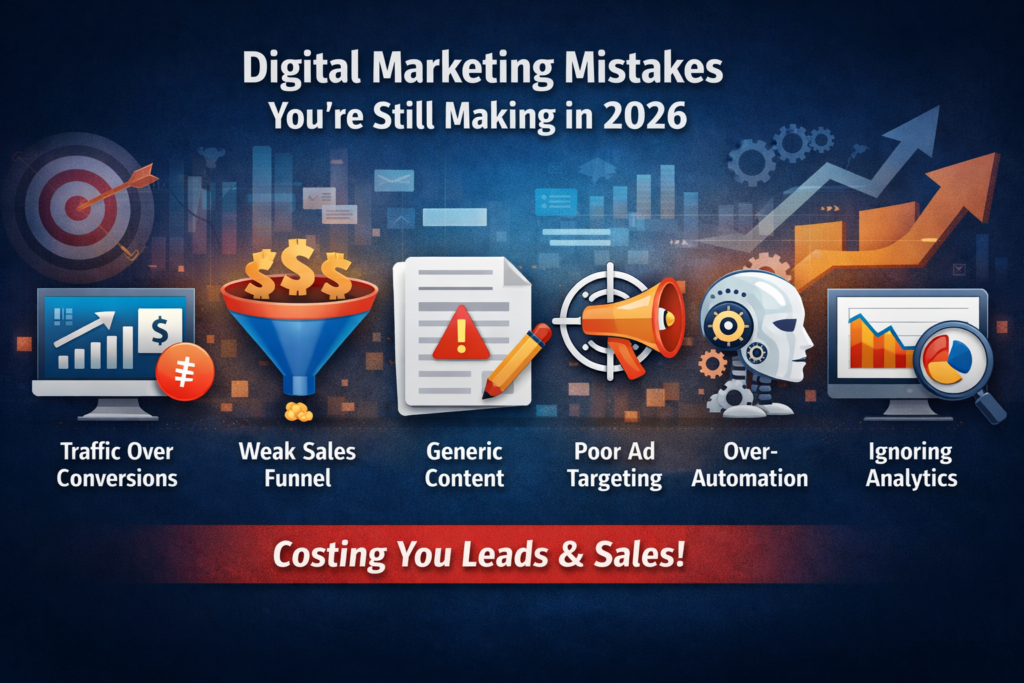
One of the biggest digital marketing mistakes 2026 continues to see is an obsession with traffic metrics. Businesses celebrate page views, impressions, and clicks, but ignore what really matters – conversions.
High traffic means nothing if visitors aren’t turning into leads or paying customers.
Instead of focusing on:
- Website sessions
- Social media reach
- Ad impressions
Start measuring:
- Cost per lead
- Conversion rate
- Customer acquisition cost
- Revenue per visitor
Shift your mindset from “more visitors” to “better-qualified visitors.”
2. Ignoring Search Intent
SEO has evolved far beyond keyword placement. In 2026, search engines prioritize content that satisfies user intent.
Many brands still create generic blogs targeting high-volume keywords without understanding why people search for them.
There are four major types of intent:
- Informational
- Navigational
- Commercial
- Transactional
If your content doesn’t match intent, it won’t rank—or convert.
To fix this:
- Study competitor content ranking on page one
- Analyze user questions
- Create in-depth, problem-solving content
Relevance now outweighs keyword density.
3. Weak Sales Funnel Strategy
Another major lead generation mistake is not having a structured funnel.
Many businesses create content randomly without guiding users toward a clear next step. A high-performing digital marketing strategy for leads includes:
Awareness Stage: Blogs, educational videos, social posts
Consideration Stage: Case studies, comparison guides, email sequences
Decision Stage: Free trials, consultations, direct offers
If you skip nurturing and jump straight to selling, potential customers leave.
In 2026, smart funnels are automated but personalized. They guide prospects naturally toward a decision.
4. Poor Conversion Optimization
You can run the best campaigns, but if your landing pages are weak, your results will suffer.
Common conversion mistakes:
- Slow website speed
- Complicated forms
- Weak call-to-actions
- No social proof
- Confusing layout
Conversion rate optimization tips that work:
- Reduce form fields
- Use clear, benefit-driven headlines
- Add testimonials and trust signals
- Improve mobile responsiveness
Small improvements in conversion rate can dramatically increase online sales without increasing ad spend.
5. Over-Reliance on Automation
Automation tools are powerful – but overusing them creates robotic marketing.
Auto-replies, generic email flows, and chatbot-only communication reduce trust. Customers expect personalization and human interaction.
Marketing automation errors to avoid:
- Sending identical emails to all subscribers
- Ignoring behavior-based triggers
- Not segmenting audiences
- Never adding manual follow-ups
Balance automation with authenticity.
6. Running Paid Ads Without Strategy
Paid advertising has become more competitive and expensive in 2026. Yet many businesses still run ads without a proper funnel or retargeting system.
Common paid ads mistakes:
- Sending traffic to the homepage instead of a landing page
- No retargeting campaigns
- Ignoring ad creative testing
- Not tracking conversions properly
To improve ROI:
- Test multiple ad creatives
- Use audience segmentation
- Track cost per acquisition
- Optimize campaigns weekly
Ad spend without tracking is financial leakage.
7. Creating Content Without Authority
Content marketing remains powerful – but only when it builds trust.
In 2026, audiences are overloaded with AI-generated content. Search engines now prioritize experience, expertise, authority, and trustworthiness (E-E-A-T).
Content marketing mistakes include:
- Publishing low-depth articles
- Rewriting common information
- Ignoring industry insights
- Not updating old content
High-ranking blogs now:
- Provide actionable steps
- Include real examples
- Offer unique insights
- Solve specific problems
Quality always beats quantity.
8. Neglecting Data and Analytics
Digital marketing without analytics is guesswork.
Yet many brands still:
- Don’t track conversion paths
- Ignore heatmaps
- Skip A/B testing
- Avoid reviewing campaign data
Data reveals:
- Where users drop off
- Which pages convert best
- Which traffic source generates revenue
- What messaging resonates
Review metrics weekly, not quarterly. Growth comes from constant optimization.
9. Inconsistent Branding Across Channels
Your website says one thing. Your social media says another. Your ads look completely different.
Inconsistent messaging confuses customers and reduces trust.
Your brand voice, visuals, and value proposition must remain consistent across:
- Website
- Social media
- Email marketing
- Paid campaigns
Consistency builds recognition. Recognition builds credibility. Credibility drives sales.
10. Expecting Immediate Results
One of the most damaging online marketing errors is impatience.
SEO takes time.
Brand authority takes time.
Audience trust takes time.
Many businesses quit campaigns after 2–3 months because they don’t see immediate results.
The brands winning in 2026 understand compounding growth. They stay consistent, refine strategies, and allow data-driven improvements to build momentum.
Final Thoughts
Digital marketing in 2026 isn’t about doing more—it’s about doing it smarter.
If you’re struggling with leads and sales, evaluate whether you’re:
- Chasing traffic instead of conversions
- Ignoring search intent
- Lacking a structured sales funnel
- Over-automating communication
- Skipping analytics and optimization
Fixing even a few of these digital marketing mistakes can significantly improve website conversions and revenue growth.
The difference between brands that struggle and brands that scale isn’t budget—it’s strategy, execution, and continuous improvement.