Search engines are no longer just ranking websites based on keywords and backlinks. Today, credibility, trust, and real expertise play a major role in determining who appears at the top of search results. This is where E-E-A-T in SEO becomes essential.
If you want sustainable rankings and long-term visibility, understanding and implementing Google’s quality standards is no longer optional — it’s mandatory.
What is E-E-A-T in SEO?
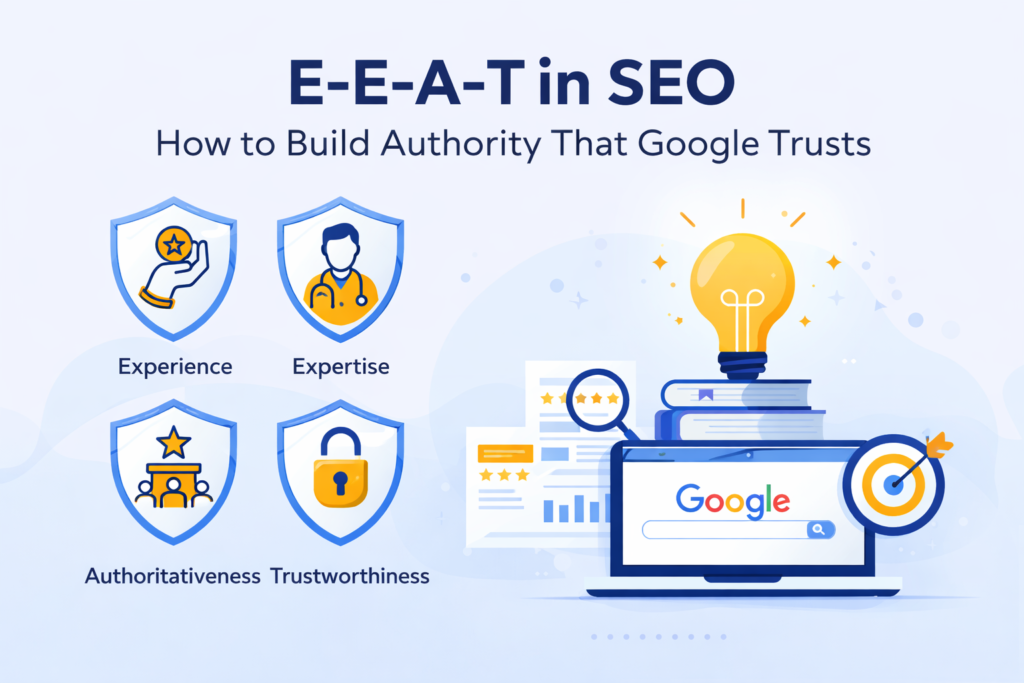
E-E-A-T stands for Experience, Expertise, Authoritativeness, and Trustworthiness. It is part of the Google E-E-A-T guidelines used by search quality evaluators to assess the credibility and value of web content.
While E-E-A-T is not a direct ranking factor in the form of a single algorithmic score, it strongly influences how Google evaluates content quality – especially for websites in sensitive niches like healthcare, finance, legal services, and news.
Let’s break it down:
- Experience – Does the content reflect real-world, first-hand experience?
- Expertise – Is the author knowledgeable or professionally qualified in the subject?
- Authoritativeness – Is the website recognized as a trusted source in its industry?
- Trustworthiness – Can users rely on the accuracy, transparency, and safety of the website?
The stronger these signals, the higher the likelihood of ranking competitively.
Why E-E-A-T Matters More Than Ever
Google’s core updates increasingly focus on rewarding high-quality, people-first content. Websites that lack credibility, publish thin content, or fail to demonstrate expertise often experience ranking drops.
Strong E-E-A-T in SEO helps:
- Improve long-term ranking stability
- Increase organic visibility
- Build brand credibility
- Enhance user trust and engagement
- Protect your site during algorithm updates
If your website falls under YMYL (Your Money or Your Life) categories – such as medical, legal, or financial – aligning with Google E-E-A-T guidelines is even more critical.
How to Build Authority in SEO Using E-E-A-T
If you’re wondering how to build authority in SEO, the answer lies in consistently strengthening all four pillars of E-E-A-T.
1. Showcase Real Experience
Google values first-hand knowledge. Include case studies, real examples, client success stories, and practical insights. Avoid generic, AI-generated sounding content without depth.
For service-based businesses, highlight project outcomes, testimonials, and documented processes.
2. Demonstrate Expertise
Content should be written or reviewed by subject matter experts. Include:
- Author bios with credentials
- Professional certifications
- Industry experience
- Linked social profiles (where relevant)
Expert-backed content significantly strengthens E-E-A-T in SEO, particularly in competitive niches.
3. Build Authoritative Signals
Authority is built over time through:
- High-quality backlinks from reputable websites
- Brand mentions across industry platforms
- Publishing in-depth, research-based content
- Earning media features or citations
Topical authority is equally important. Instead of publishing scattered content, create structured content clusters around core themes.
4. Strengthen Website Trust Signals
Trust is often the deciding factor. Ensure your website includes:
- Clear contact information
- About Us page with transparent details
- Privacy policy & terms pages
- Secure HTTPS protocol
- Accurate, updated information
Trust signals directly align with Google E-E-A-T guidelines and improve both user confidence and search engine perception.
Content Quality Still Comes First
No amount of technical SEO can replace high-value content. To improve E-E-A-T in SEO, focus on:
- Solving real user problems
- Covering topics comprehensively
- Writing clear, structured, and well-researched content
- Updating outdated pages regularly
- Avoiding clickbait or misleading claims
Google rewards helpful content created for users – not just search engines.
Common Mistakes That Hurt E-E-A-T
Many websites unknowingly weaken their authority by:
- Publishing thin, low-effort blog posts
- Not mentioning authors or credentials
- Overusing AI content without human review
- Ignoring website security and transparency
- Building spammy backlinks
If you’re serious about learning how to build authority in SEO, avoiding these mistakes is just as important as implementing best practices.
Final Thoughts
E-E-A-T is not a short-term ranking hack – it is a long-term credibility framework. Businesses that focus on experience, expertise, authority, and trust consistently outperform competitors relying only on keywords and backlinks.
By aligning your strategy with Google E-E-A-T guidelines, you future-proof your website against algorithm updates and build sustainable organic growth.
If your goal is to create lasting search visibility, now is the time to prioritize E-E-A-T in SEO and implement a structured strategy that strengthens your digital authority.