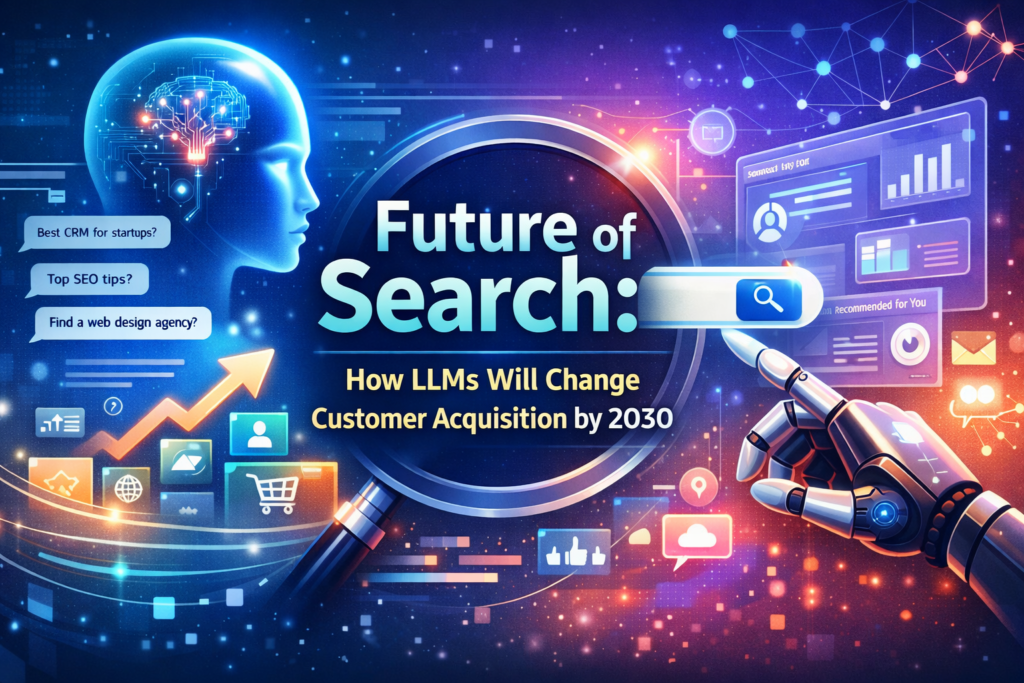
Search is evolving faster than ever. For nearly two decades, businesses relied on traditional search engines like Google to attract customers through organic rankings and paid advertising. However, the rise of Large Language Models (LLMs) such as ChatGPT, Gemini, and Copilot is transforming the way users discover information online.
By 2030, search will no longer be limited to typing keywords into a search engine. Instead, users will interact with AI-powered assistants that deliver direct, personalized answers, recommendations, and even automated decisions. For businesses, this shift will fundamentally change how customer acquisition works.
Understanding the future of search today will help organizations stay competitive in the AI-driven digital ecosystem.
The Evolution of Search: From Links to AI Answers
Traditional search engines operate on a familiar model: users type a query, and the search engine returns a list of links. Businesses compete for visibility by ranking higher in search results using SEO.
LLM-powered search changes this dynamic dramatically. Instead of presenting links, AI systems synthesize information from multiple sources and generate a direct answer to the user’s question.
For example:
- A user may ask: “What is the best CRM for startups under $50/month?”
- Instead of showing ten blue links, an AI assistant may provide a complete comparison with recommendations.
This shift creates a new search environment often called:
- Answer Engines
- AI Search
- Generative Search
For marketers, the challenge is clear: your brand must appear in AI-generated answers, not just traditional search results.
Why LLMs Are Transforming Customer Acquisition
LLMs are changing the entire customer journey—from discovery to decision-making.
1. Conversational Search Replaces Keyword Search
Search queries are becoming more natural and conversational. Instead of short keywords like:
“best digital marketing agency”
Users now ask detailed questions such as:
“Which digital marketing agency is best for SEO for eCommerce brands?”
LLMs understand context, intent, and nuance far better than traditional search engines. This means businesses must optimize content for topics and questions, not just keywords.
2. AI Becomes the First Touchpoint With Customers
Historically, websites served as the first interaction between a brand and a potential customer.
In the future, AI assistants will act as the first point of contact. These systems will analyze multiple data sources—including websites, reviews, articles, and databases—to recommend solutions.
This means:
- AI may recommend a service provider directly.
- Customers may never visit multiple websites before deciding.
- Brand visibility will depend on how often AI systems cite your business.
3. Zero-Click Search Will Become the Norm
AI-powered search experiences increasingly provide answers without requiring users to click on websites. This trend, often called zero-click search, is already visible with AI summaries and overviews in search engines.
For businesses, this means traffic may decline while brand visibility inside AI answers becomes more important.
New metrics will emerge, including:
- AI mentions
- Answer engine citations
- AI-generated brand recommendations
4. AI Personalization Will Influence Purchase Decisions
By 2030, search will become deeply personalized.
LLMs will use factors such as:
- User behavior
- Past searches
- Preferences
- Location
- Context
This means two users asking the same question may receive completely different recommendations.
For marketers, customer acquisition will shift toward intent-driven, personalized content strategies rather than broad targeting.
The Rise of Generative Engine Optimization (GEO)
As AI search grows, traditional SEO alone will not be enough.
A new discipline called Generative Engine Optimization (GEO) is emerging. GEO focuses on optimizing digital content so that AI systems cite and reference it in their responses.
Key GEO strategies include:
1. Creating Answer-Focused Content
LLMs extract specific answers rather than entire articles. Structured content like FAQs, definitions, and step-by-step guides increases the chances of being cited.
2. Building Topical Authority
AI models prefer content from credible and authoritative sources. Creating in-depth content clusters around specific topics helps establish authority.
3. Using Structured Data
Structured data and semantic markup help AI systems understand content more effectively.
4. Strengthening Trust Signals
AI prioritizes trustworthy sources that demonstrate expertise, authority, and credibility.
These practices will define the future of digital marketing.
AI Agents Will Redefine Search Behavior
Another major change is the rise of AI agents.
Instead of searching manually, users may delegate tasks to AI systems such as:
- “Plan my vacation to Europe.”
- “Find the best accounting software for my company.”
- “Recommend a reliable SEO agency.”
Future AI models will not only retrieve information but also analyze options, compare solutions, and make recommendations.
This means businesses must optimize their online presence for AI decision-making systems, not just human users.
How Businesses Can Prepare for AI-Driven Search
Organizations that adapt early will gain a major competitive advantage.
1. Invest in AI-Ready Content
Content should be:
- Structured and easy for AI to interpret
- Based on real questions users ask
- Comprehensive and authoritative
AI prefers content that clearly answers user queries.
2. Focus on Authority and Brand Reputation
LLMs prioritize trusted sources when generating responses. Building authority through:
- High-quality content
- Media mentions
- Industry citations
- Expert insights
will improve visibility in AI search results.
3. Optimize for Multi-Platform Discovery
The future of search extends beyond Google.
Brands must optimize for platforms such as:
- ChatGPT
- Gemini
- Perplexity
- Voice assistants
- AI-powered browsers
These systems will increasingly influence purchasing decisions.
4. Monitor AI Visibility
Traditional SEO metrics like rankings and traffic will no longer tell the full story.
Businesses should also track:
- AI citations
- AI answer appearances
- Brand mentions in generative responses
These metrics will define success in the AI search ecosystem.
What Customer Acquisition Will Look Like in 2030
By the end of the decade, the customer acquisition funnel will look very different.
Instead of this:
Search → Website → Comparison → Purchase
It may become:
AI Query → AI Recommendation → Decision
AI will act as a trusted advisor, guiding users toward products, services, and brands that best match their needs.
Companies that adapt their SEO and content strategies for AI-powered search will gain significant advantages in visibility, credibility, and customer acquisition.
Conclusion
The future of search is shifting from search engines to answer engines. Large Language Models will redefine how information is discovered, how brands are recommended, and how customers make decisions.
For businesses, this transformation represents both a challenge and an opportunity. Traditional SEO strategies must evolve into AI-driven optimization strategies that focus on authority, structured content, and AI visibility.
By preparing for this change today, organizations can ensure they remain visible and competitive in the rapidly evolving world of AI-powered search.