The digital marketing landscape in 2026 is no longer divided into rigid channels. Instead, strategies are blending together—and one of the most important overlaps today is between SEO (Search Engine Optimization) and GEO (Geographic Optimization).
If you’re wondering whether SEO and GEO are separate, complementary, or almost identical—the reality lies somewhere in between. They share a strong foundation, but each brings a unique layer of value. Understanding how much they overlap can help you build smarter strategies that drive both traffic and conversions.
SEO vs GEO: A Quick Context
SEO focuses on improving a website’s visibility in search engines for relevant queries. It includes content optimization, keyword targeting, technical improvements, and link building.
GEO, however, narrows this approach by aligning content and campaigns with specific geographic locations. It ensures your business appears when users search within a defined area, such as a city or region.
Rather than competing strategies, GEO acts as a precision layer added on top of SEO.
How Much Do SEO and GEO Actually Overlap?
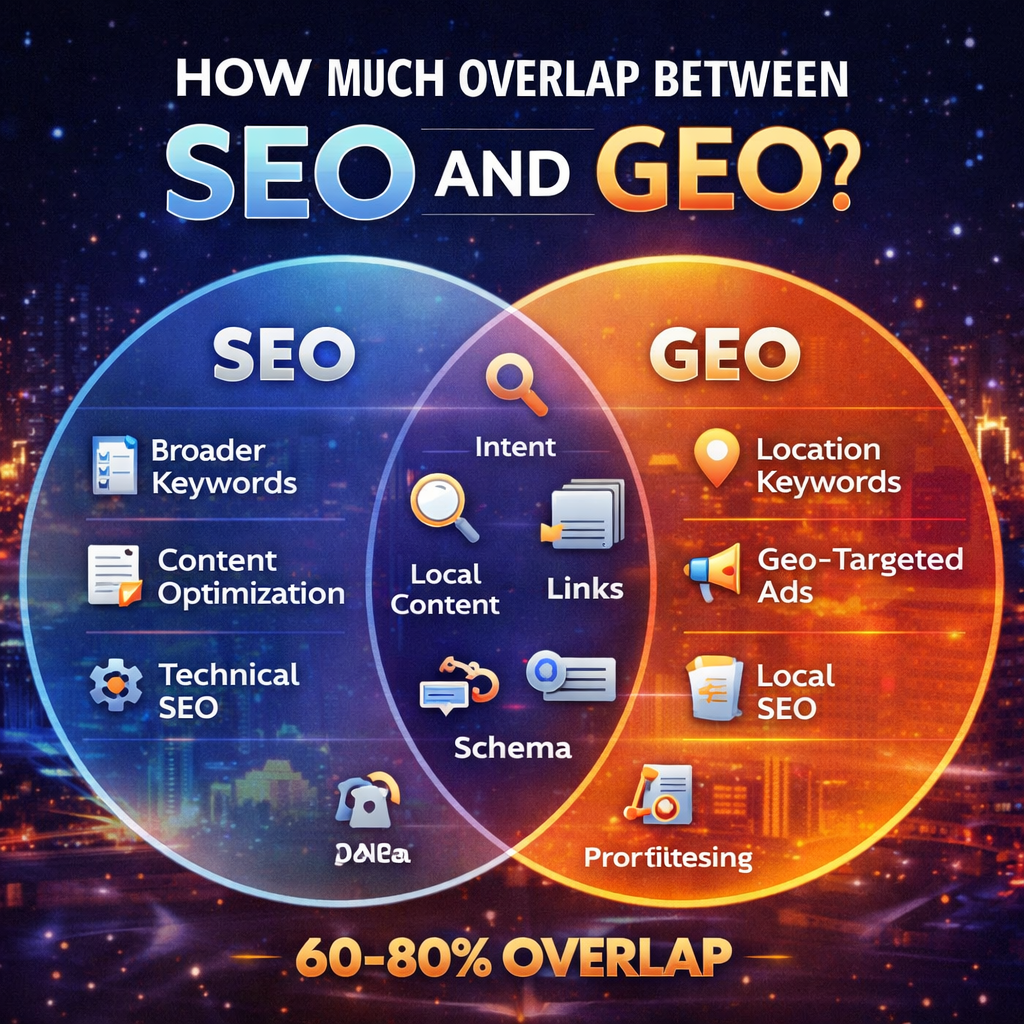
The overlap between SEO and GEO is substantial—often estimated at 60–80%, depending on the business type. For local businesses, the overlap is even higher because most of their visibility depends on location-driven searches.
The reason for this strong overlap is simple: both strategies rely on the same core pillars—content, keywords, user intent, and search engine signals. GEO doesn’t replace these elements; it enhances them with geographic relevance.
1. Keyword Strategy: Where the Overlap Begins
At the core of both SEO and GEO lies keyword research. However, GEO modifies traditional keywords by adding location-specific intent.
For instance:
- “SEO services” becomes “SEO services in Delhi”
- “best digital marketing agency” becomes “best digital marketing agency near me”
High search volume keyword variations include:
- local SEO services near me
- digital marketing agency in India
- geo-targeted advertising
- location-based marketing strategies
- SEO company in Delhi NCR
- hyperlocal SEO services
Both SEO and GEO require understanding search demand, but GEO makes keywords more transactional and conversion-focused.
2. Content Creation: Shared Foundation, Different Focus
Content is where the overlap becomes even more visible. SEO prioritizes informative, valuable, and keyword-optimized content. GEO builds on this by making the content location-aware and contextually relevant.
For example, instead of writing a general guide on “digital marketing strategies,” GEO pushes you to create:
- “Digital marketing strategies for small businesses in Delhi”
- “Local SEO strategies for Indian startups”
The structure, optimization techniques, and readability standards remain the same—but GEO ensures the content connects with a specific audience segment.
3. Search Intent: The Real Point of Convergence
Modern SEO is driven by intent, not just keywords. GEO takes this one step further by aligning intent with location-based urgency.
A search like “buy laptop online” is broad and informational. But “buy laptop store near me” signals immediate intent to act. GEO ensures your business shows up for these high-conversion queries.
Search engines now interpret:
- Proximity
- Device location
- Real-time context
This makes GEO a natural extension of intent-based SEO, rather than a separate strategy.
4. Local SEO: The Strongest Overlap Zone
Local SEO is where SEO and GEO practically merge. It includes optimizing your digital presence to appear in local search results, maps, and business listings.
This involves:
- Optimizing Google Business Profile
- Managing local citations
- Encouraging customer reviews
- Maintaining consistent business information
Local SEO is essentially SEO powered by GEO signals, making it one of the most effective ways to capture high-intent traffic.
5. Technical Optimization: Shared Infrastructure
Both SEO and GEO depend on strong technical foundations. Without proper technical optimization, neither strategy can perform effectively.
Shared technical elements include:
- Mobile-friendly design
- Fast page loading speed
- Structured data (schema markup)
- Proper indexing and crawlability
GEO enhances this by adding location-specific schema, such as local business markup, which helps search engines understand your geographic relevance.
Where SEO and GEO Differ
Despite the strong overlap, there are clear differences that define each strategy’s role:
- SEO targets a broad or global audience, while GEO focuses on specific locations
- SEO keywords are often competitive and generic, whereas GEO keywords are more niche and targeted
- GEO typically delivers higher conversion rates due to localized intent
- SEO builds overall authority, while GEO builds regional dominance
Understanding these differences helps you balance both strategies effectively.
Why This Overlap Matters for Businesses
The growing overlap between SEO and GEO is not just a technical detail—it has real business implications.
When you combine both strategies, you don’t just increase traffic; you attract qualified traffic. Users who find your business through geo-targeted searches are more likely to convert because they are actively looking for nearby solutions.
Additionally, GEO reduces competition by narrowing your focus. Ranking globally for a keyword can be difficult, but ranking locally is often more achievable and profitable.
How to Leverage the Overlap Effectively
To fully benefit from the synergy between SEO and GEO, businesses need an integrated approach rather than treating them separately.
Start by blending your keyword strategy. Use high-volume keywords but combine them with location modifiers to capture both broad and local searches.
Next, create content that speaks directly to specific regions. Avoid generic pages and instead develop location-focused landing pages with unique insights.
Strengthen your local presence by optimizing business listings, collecting reviews, and ensuring consistency across platforms. These signals play a crucial role in GEO performance.
Finally, monitor performance separately for global and local keywords. This helps you understand how each strategy contributes to your overall growth.
Common Misconceptions About SEO and GEO
One common misconception is that GEO is only useful for small or local businesses. In reality, even large brands use GEO to target different regions with tailored campaigns.
Another misunderstanding is that adding a city name to content is enough. Effective GEO requires deeper optimization, including local context, user intent alignment, and technical signals.
The Future: Full Integration of SEO and GEO
Looking ahead, the distinction between SEO and GEO will continue to fade. With advancements in AI, voice search, and personalized search experiences, location will become a default factor in almost every query.
Search engines are moving toward delivering results that are not just relevant—but contextually and geographically precise. This means GEO will become an inseparable part of SEO strategies.
Final Thoughts
So, how much overlap is there between SEO and GEO? The answer is clear: a significant and growing overlap that cannot be ignored.
SEO provides the foundation—visibility, authority, and reach. GEO refines that foundation by adding location-based precision and relevance.
Businesses that understand and leverage this overlap will not only rank higher but also connect more effectively with their audience, driving better engagement and higher conversions.
In today’s search ecosystem, success doesn’t come from choosing between SEO and GEO—it comes from integrating both into a unified strategy.