
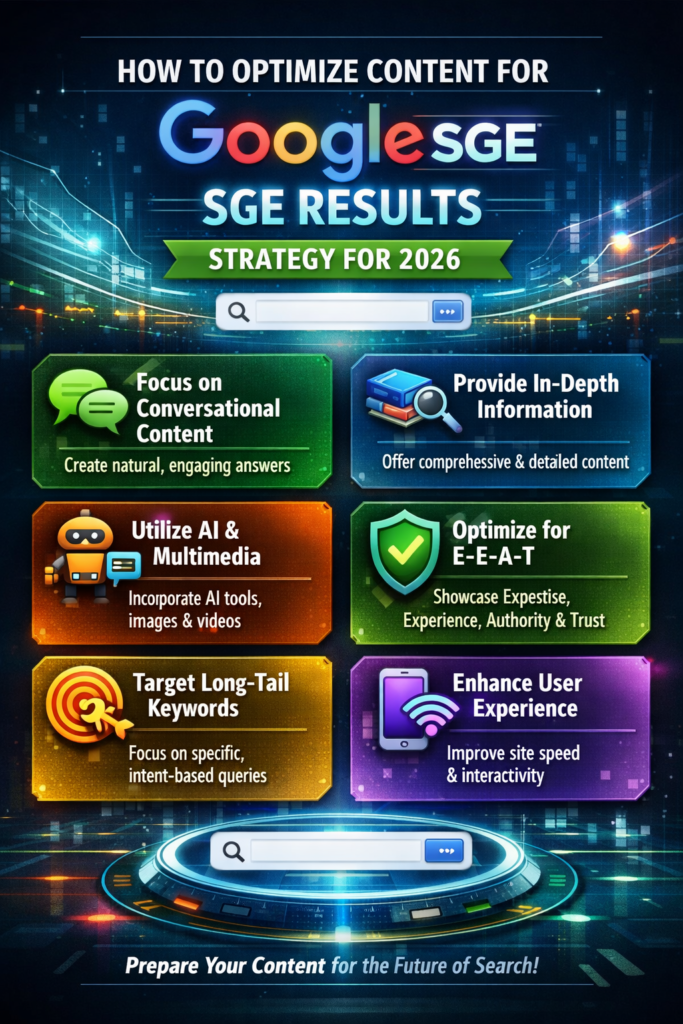
Google’s Search Generative Experience has permanently altered the relationship between content and ranking. Google’s SGE doesn’t just surface links – it reads your pages, evaluates their authority, extracts the most useful information, and synthesises an answer before the user ever clicks. If your content isn’t structured for that extraction, it becomes invisible regardless of how high it traditionally ranked.
This guide breaks down exactly what needs to change in how you write, structure, and publish content in 2026 to earn a consistent presence inside SGE’s AI-generated answers.
Quick Reference: SGE Optimization at a Glance
| Challenge | What to Do | Expected Result |
| Dense, unstructured prose | Rewrite with modular blocks, query headers, and summary boxes | More frequent inclusion in SGE source carousels |
| No original data or insight | Add proprietary stats, named frameworks, and case studies | Treated as a primary source; higher AI citation rate |
| Keyword repetition without context | Map entities and cover related concepts with expert depth | Stronger entity confidence in Google’s Knowledge Graph |
| Thin or missing E-E-A-T signals | Add author bios with schema, expert quotes, and fact-check notes | Elevated authoritativeness score in AI ranking filters |
| Content buried below the fold | Lead with a 40–60-word direct answer to the query | Increased likelihood of becoming the AI snapshot source |
1. Write for the AI First, the Human Second
SGE functions as a synthesis engine. It scans multiple pages simultaneously, identifies the most coherent and credible answer fragments, and assembles a response. Your page is competing not just for a click, but to be the source the AI quotes.
This requires a fundamental shift from narrative-first writing to answer-first architecture. Every page should be built so that an AI reading it in isolation can identify, in under five seconds, what question it answers, what the core answer is, and why that answer is credible.
| ✅ Key Takeaway Stop writing to keep readers on the page. Write so that an AI can extract your answer in under three seconds. Clarity and structure now directly influence whether your brand appears in the AI snapshot. |
2. The Modular Content Framework
Traditional blog posts are written as flowing essays. SGE-ready content is structured in self-contained modules — each capable of standing alone as an answer to a specific sub-question.
Anatomy of a High-Performing SGE Module
- Query Header: A question-phrased H2 that mirrors how a user would actually search.
- Atomic Answer: Two to three sentences that deliver the section’s core value immediately.
- Structured Proof: A list, comparison table, or stat block the AI can lift directly.
- Contextual Deep-Dive: 200–300 words of expert analysis that adds depth and E-E-A-T signals.
This structure gives the AI multiple ‘entry points’ into your content. Even if the user’s prompt only partially matches your article’s topic, a well-designed module can still be surfaced as the relevant answer.
3. Lead With the Answer: The 40–60-Word Rule
The practice of burying your conclusion at the end of a long post — to increase time-on-page — actively penalises you in the SGE era. Google’s AI rewards pages that resolve the query immediately.
Your opening paragraph should deliver the direct answer in 40 to 60 words. This length is the sweet spot: detailed enough to be informative, concise enough to be extracted without editing. Think of it as writing the AI’s quote before it asks for one.
| 📊 Data Point Pages that placed the primary answer within the first 100 words were selected as SGE snapshot sources at a significantly higher rate than those burying answers in the body. Format your first paragraph as if it will be the only thing the AI reads. |
4. Earn AI Citations Through Original Research
AI models are trained to synthesise existing knowledge. The problem is that “existing knowledge” often means widely repeated, consensus-level information. Publishing what everyone else already says makes your content interchangeable with a hundred other sources.
To earn a citation – rather than just an implied summary – you need to provide what researchers call information gain: something the AI cannot find already synthesised elsewhere.
Three Ways to Create Citeable Original Content
- Proprietary Statistics:Survey your customers or analyse your platform data and publish the findings. Even a sample size of 50 with a clear methodology outperforms recycled statistics.
- Original Frameworks:Develop and name a process or approach unique to your methodology. Named frameworks are far more citeable than generic advice because they create a specific entity the AI can attribute.
- Real-World Case Studies:Document real client outcomes with measurable before-and-after data. Case studies signal the ‘Experience’ dimension of E-E-A-T that pure editorial content cannot replicate.
5. E-E-A-T Is Now a Technical Requirement
Experience, Expertise, Authoritativeness, and Trustworthiness have always been Google quality guidelines. In the SGE era, they function more like a hard filter. The AI gives significant weight to signals that confirm who is speaking and whether that voice is qualified.
The shift is important: it is no longer enough to write authoritatively. You must signal authority through structured, machine-readable metadata that the AI can evaluate independently of the prose.
Practical E-E-A-T Implementation Checklist
- Deploy Person schema on every author bio page, linking to professional profiles and credentials
- Include a named, qualified expert in each article — either as the author or as a cited reviewer
- Add a visible “Fact-Checked By” or “Reviewed By” line with a linked bio
- Reference primary sources (studies, government data, official documentation) rather than secondary coverage
- Keep publication dates current and add a “Last Updated” timestamp in your page schema
6. Entities Over Keywords: How the AI Reads Your Content
Keyword density is a legacy metric. What the SGE AI actually evaluates is entity confidence – how clearly your content establishes your brand, your expertise, and your relationship to a topic within Google’s Knowledge Graph.
Rather than repeating a target phrase five times, focus on covering the conceptual neighborhood of your topic. A page about AI search optimization should naturally reference large language models, retrieval-augmented generation, entity mapping, and structured data – not because these are keywords, but because they are the concepts that define the space.
| 💡 Practical Tip Before writing any section, list the five most important related concepts or entities. Then ensure every module references at least two of them in context. This entity mapping signals topical authority to the Knowledge Graph without any keyword stuffing. |
7. Formatting for Extract-Ability
If the AI cannot parse your content structure quickly, it will default to a source that is easier to process. Extract-ability – how easily your data can be lifted and re-used – is effectively a ranking signal for SGE.
Formatting Signals That Improve AI Extraction
- Tables for comparisons: Comparison data should always live in a table. SGE frequently lifts table rows directly into its comparison grids, preserving your attribution in the process.
- Lists for processes: Any multi-step process — a workflow, a methodology, a guide — should be a numbered or bulleted list. The AI is trained to recognise lists as high-information-density content.
- Bold key phrases: Use bold text to mark the most important phrase in each paragraph. This subtly guides the AI to the nucleus of your point and increases the likelihood that phrase is extracted.
- Summary boxes:Summarize each major section in a callout or highlighted box. These function as pre-written AI captions that make your content significantly easier to quote.
- Images and video: Original images with detailed, keyword-rich alt text provide additional entry points into SGE’s multimodal results. Add VideoObject schema if you are embedding video.
8. Optimising Existing Content Without Starting Over
A full content rewrite is rarely necessary. Most pages can be upgraded for SGE with targeted structural changes that take less than an hour each.
| Upgrade Action | How to Apply It |
| Add an Atomic Answer paragraph | Write a 40–60-word direct answer and insert it as the very first paragraph under your H1 |
| Insert Key Takeaway boxes | Summarise each major section in a shaded box or blockquote at the top of the section |
| Convert prose lists to bullet points | Find any sentence containing ‘firstly’, ‘additionally’, or commas listing items — reformat as a bulleted list |
| Rewrite H2s as questions | Change ‘Benefits of X’ to ‘What are the main benefits of X?’ — this matches conversational search patterns |
| Add FAQPage schema | Mark up your existing FAQ section with structured data — this triggers AI Overview appearances without changing the visible content |
| Update the author bio | Add a detailed bio with Person schema linking to professional credentials and external profiles |
Frequently Asked Questions
Does content length still matter for SGE?
Length matters less than information density. A 600-word article structured in modular blocks with original data will consistently outperform a 2,500-word essay that buries its key points. Aim for the shortest article that fully satisfies the query — with every paragraph earning its place.
How long should the Atomic Answer paragraph be?
Between 40 and 60 words. This range is long enough to be genuinely informative and short enough to be extracted without modification. Below 40 words often feels incomplete; above 60 tends to get truncated or paraphrased by the AI, which reduces direct attribution.
Should I use a formal or conversational tone for SGE?
Use an authoritative conversational tone — the kind used in a high-quality expert briefing rather than either an academic paper or a casual blog post. SGE is used conversationally but evaluated editorially. Clarity, precision, and directness outperform both excessive formality and casual rambling.
Does SGE favour multimedia content over text?
SGE is increasingly multimodal. Original images with descriptive, keyword-rich alt text and VideoObject schema both improve indexation and provide additional citation entry points. That said, strong textual structure remains the primary factor. Treat multimedia as a supplement that adds extractable context, not a replacement for well-structured prose.
How quickly do SGE optimisation changes take effect?
Most sites see measurable changes in AI snapshot appearance within four to eight weeks of substantive structural updates, assuming the page is being crawled regularly. Schema additions (FAQPage, Person, HowTo) tend to show impact faster than prose changes because they are machine-readable immediately on recrawl.
Conclusion: Build Content That Survives Synthesis
The brands that will win in the SGE era are not those publishing the most content – they are the ones whose content is most extractable, most credible, and most original. Google’s AI does not reward volume; it rewards signal clarity.
Optimizing for SGE is not a one-time audit. It is a production philosophy: every article should begin with the answer, build outward in self-contained modules, cite original data, and close with structured FAQ markup. Apply this consistently and your content stops being a source that sometimes gets found – it becomes the source that gets synthesised.