
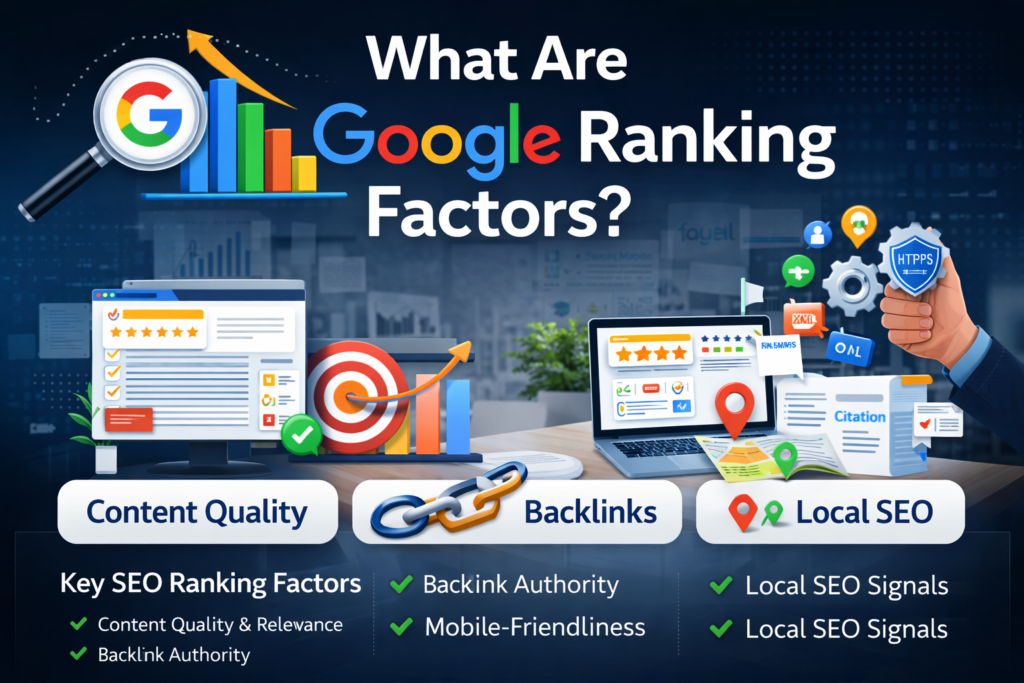
Search engines use complex algorithms to determine which web pages appear in search results. Among these algorithms, Google ranking factors play a crucial role in deciding the visibility and position of a website. Understanding these factors is essential for businesses, marketers, and website owners who want to improve their search presence and attract organic traffic.
Although Google does not publicly disclose all elements of its ranking algorithm, industry research and testing have revealed several important SEO ranking factors that influence search rankings. These factors help Google evaluate the quality, relevance, and authority of a webpage before displaying it in search results.
What Are Google Ranking Factors?
Google ranking factors are the signals or criteria that search engines use to evaluate and rank web pages. These signals help Google determine which pages provide the most useful and relevant information for a user’s search query.
The algorithm considers hundreds of signals, including content quality, website performance, backlinks, user experience, and location relevance. By optimizing these SEO ranking factors, websites can improve their chances of appearing higher in search results.
High-Quality Content
Content remains one of the most important SEO ranking factors. Google aims to deliver helpful and relevant information to users, so websites with well-written, informative content often perform better in search results.
High-quality content should:
- Address user search intent clearly
- Provide accurate and useful information
- Include relevant keywords naturally
- Be well-structured with headings and readable formatting
Content that answers user questions effectively tends to gain more engagement and backlinks, which further strengthens its ranking potential.
Keyword Relevance
Keywords help search engines understand the topic of a webpage. Proper keyword usage is an essential part of optimizing for Google ranking factors.
However, keyword usage should always remain natural and focused on readability. Overusing keywords can harm search performance. Instead, keywords should appear strategically in important areas such as:
- Page titles
- Headings
- Meta descriptions
- Image alt text
- Body content
Balanced keyword placement allows search engines to recognize the relevance of a page without compromising the user experience.
Backlinks and Website Authority
Backlinks are one of the strongest SEO ranking factors because they signal credibility and trust. When reputable websites link to a page, it indicates that the content provides value.
Search engines evaluate several aspects of backlinks, including:
- The authority of the linking website
- Relevance between the linking page and the destination page
- The number of referring domains
- Natural link-building patterns
Websites that earn links from trusted sources generally achieve stronger search visibility.
Website Speed and Performance
Website performance is another critical element among Google ranking factors. Fast-loading websites provide a better user experience and reduce bounce rates.
Google measures performance through metrics such as page loading speed and overall site responsiveness. Websites that load quickly across both desktop and mobile devices are more likely to rank higher.
Improving site speed often involves optimizing images, reducing unnecessary scripts, and using efficient hosting infrastructure.
Mobile Friendliness
With the majority of searches now performed on mobile devices, mobile usability has become a key part of modern SEO ranking factors.
Google uses mobile-first indexing, meaning it primarily evaluates the mobile version of a website for ranking purposes. A website that works smoothly on smartphones and tablets is more likely to perform well in search results.
Mobile-friendly websites typically include responsive design, easy navigation, readable text, and properly scaled images.
User Experience Signals
User experience plays an increasing role in Google ranking factors. When users interact positively with a website, it indicates that the content is useful and relevant.
Some behavioral signals that may influence rankings include:
- Click-through rate from search results
- Time spent on the page
- Bounce rate
- Ease of navigation
Although these metrics alone do not determine rankings, they provide valuable indicators of content quality and user satisfaction.
Technical SEO Factors
Technical optimization ensures that search engines can easily crawl, index, and understand a website. Several SEO ranking factors fall under technical SEO.
Important technical elements include:
- Proper site structure and internal linking
- Secure HTTPS connections
- XML sitemaps
- Clean URL structures
- Proper use of structured data
When technical issues are minimized, search engines can index pages more efficiently, improving overall visibility.
Local SEO Ranking Factor
For businesses that serve specific geographic areas, local optimization becomes essential. A strong local seo ranking factor strategy helps businesses appear in location-based search results.
Key local ranking signals include:
- Accurate business listings
- Consistent name, address, and phone number information
- Customer reviews and ratings
- Localized website content
- Google Business Profile optimization
When these local signals are optimized, businesses are more likely to appear in local search results and map listings.
Content Freshness and Updates
Regular updates and fresh content also influence Google ranking factors. Search engines prefer websites that maintain updated and relevant information.
Refreshing existing content, adding new insights, and updating outdated statistics can help maintain strong search visibility. This practice also signals that the website is actively maintained and relevant to users.
Final Thoughts
Understanding Google ranking factors is essential for building a successful SEO strategy. While search algorithms continue to evolve, the core principles remain consistent: provide high-quality content, maintain strong technical performance, and create a positive user experience.
By focusing on proven SEO ranking factors, websites can improve their visibility and attract consistent organic traffic. Businesses that also optimize key local seo ranking factor signals can strengthen their presence in location-based searches and connect with nearby customers.
Search engine optimization is an ongoing process, but a strong focus on these ranking signals helps build long-term search success.