For modern marketers and business owners—often acting as a “Chief Everything Officer”—time is the most limited asset. Manually tracking keyword rankings across different areas or logging into multiple platforms to manage reviews is no longer practical. This is exactly where the best tools for GEO and SEO integration become essential for scaling efficiently.
In 2026, search behavior has become highly location-sensitive. Search engines now deliver different results depending on whether a user is in a commercial hub, residential area, or even a few streets away. To stay competitive, businesses need tools that combine SEO performance tracking with geo-targeting precision, ensuring visibility across every relevant location.
Key Challenges and Smart Solutions
Businesses integrating GEO and SEO often face similar challenges. The right tools can directly solve these issues and improve performance outcomes:
| Problem | Action | Outcome |
|---|---|---|
| Difficulty tracking rankings across multiple areas | Use geo-grid rank tracking tools like Local Falcon | Clear visibility into ranking gaps across locations |
| Managing reviews and updates for multiple listings | Use platforms like BrightLocal | Improved engagement and stronger local trust signals |
| Irrelevant content shown to users from different regions | Implement Geo Targetly for geo-based personalization | Better user experience and higher conversion rates |
Best Local SEO Tools for Small Businesses in 2026
The local SEO tool landscape has matured, with a few platforms offering comprehensive solutions. For small and medium businesses, these tools stand out:
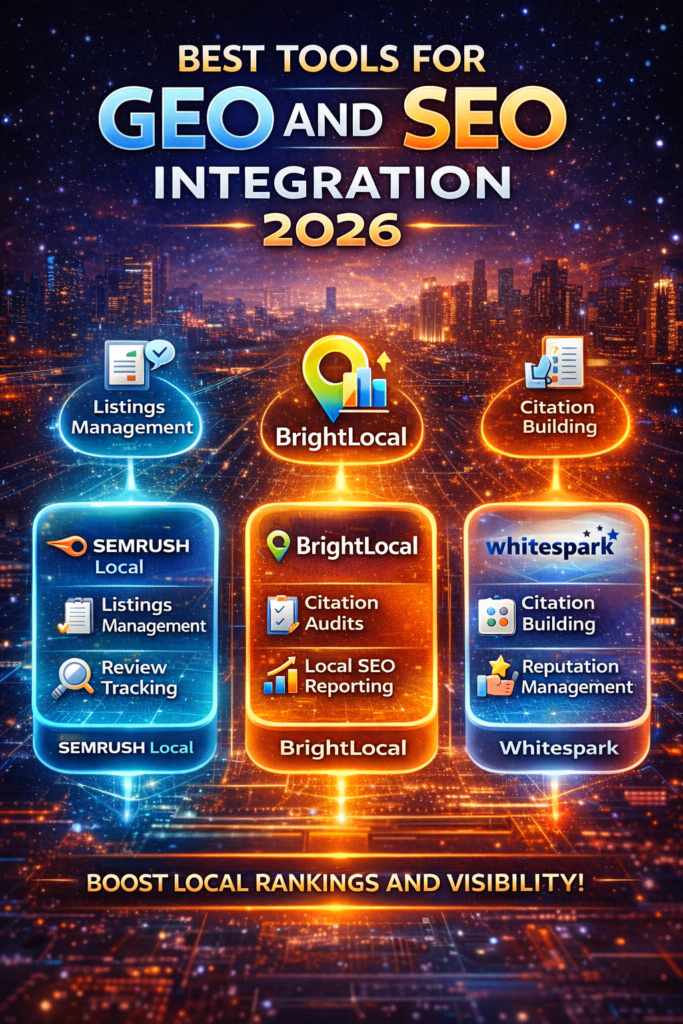
Semrush Local
This is a powerful all-in-one platform that combines keyword research, listing management, and local rank tracking. It is particularly useful for businesses that want to integrate local SEO data with broader SEO strategies in one dashboard.
BrightLocal
BrightLocal is known for its strong focus on local SEO audits and reporting. Its citation tracking feature helps identify where your business is listed and where competitors have an advantage, making it ideal for improving local visibility.
Whitespark
Whitespark excels in citation building and reputation management. It is especially useful for businesses that need to clean up inconsistent listings or build authority in specific geographic areas.
How Geo-Grid Rank Tracking Improves Local Visibility
Traditional rank tracking tools provide a single ranking position, but that does not reflect how rankings change across different areas. In local SEO, your position can vary significantly depending on the user’s exact location.
Geo-grid rank trackers solve this problem by mapping rankings across multiple points within a selected area. This creates a visual heatmap showing where your business performs well and where it struggles.
For example, if rankings drop in certain neighborhoods, you can focus on:
- Creating location-specific content
- Building local backlinks
- Improving relevance for that area
This approach allows for data-driven GEO optimization, rather than guesswork.
Tools for Automating Google Business Profile Management
Managing a Google Business Profile manually can be time-consuming, especially for businesses with multiple locations. Automation tools simplify this process by centralizing control and improving efficiency.
Publer and Sendible
These tools allow you to schedule posts for your business profile, similar to social media scheduling. This ensures consistent updates without manual effort.
BrightLocal GBP Tools
BrightLocal provides insights into how users discover your business, including whether they find you through branded searches or general discovery queries. This data helps refine your GEO strategy.
Tracking Keyword Rankings by Location
Advanced SEO tools now allow businesses to track rankings at a highly specific level, including zip codes or exact addresses. This is particularly valuable in competitive urban markets where rankings can change within short distances.
Tools like Nightwatch and Advanced Web Ranking enable:
- Hyperlocal keyword tracking
- Performance comparison across locations
- More accurate reporting for GEO campaigns
This level of detail ensures that your SEO strategy aligns with real-world user behavior.
BrightLocal vs Whitespark: Key Differences
Both BrightLocal and Whitespark are widely used in local SEO, but they serve slightly different purposes.
BrightLocal is more focused on providing a complete dashboard for tracking, reporting, and auditing. It is ideal for ongoing performance monitoring and campaign management.
Whitespark, on the other hand, is known for its hands-on approach to citation building and cleanup. It is particularly useful when businesses need to fix inconsistent listings or strengthen their presence across directories.
Choosing between them depends on whether you need automation and reporting or manual optimization and citation building.
Using Geo Targetly for Location-Based Personalization
Geo Targetly is a powerful tool for improving user experience through location-based targeting. It detects a user’s location and delivers content tailored to their region.
For example, if your business operates in multiple cities, you can:
- Redirect users to the correct city page
- Display region-specific offers
- Show relevant testimonials and case studies
This reduces bounce rates and increases engagement by ensuring users see content that is directly relevant to their location.
Free Tools for Local SEO Audits
While premium tools provide deeper insights, there are free options available for businesses starting with GEO and SEO integration.
Moz Check Presence
This tool scans major directories to verify whether your business information is accurate and consistent.
Google Search Console
By analyzing performance data, you can identify location-based queries and understand how your site appears in local search results.
These tools are a good starting point for identifying gaps before investing in advanced platforms.
How AI is Enhancing GEO and SEO Tools
Artificial intelligence is playing a major role in improving how GEO and SEO tools function in 2026. Modern platforms now use AI to automate and enhance various aspects of optimization.
Sentiment Analysis
AI can analyze customer reviews and identify patterns, helping businesses understand common feedback across locations.
Content Optimization
Tools can suggest local keywords, landmarks, and entities to improve geographic relevance in content.
Predictive Insights
AI can evaluate competition in specific areas and suggest where businesses have the best chance to rank.
These capabilities make GEO + SEO strategies more efficient and data-driven.
Final Thoughts: Building a Future-Ready GEO + SEO Stack
Investing in the right tools for GEO and SEO integration is no longer optional—it is essential for staying competitive in 2026. Businesses that automate their workflows, track performance across locations, and personalize user experiences will have a clear advantage.
By combining tools for keyword research, local optimization, rank tracking, and AI-driven insights, you can create a powerful strategy that delivers both visibility and conversions.
The goal is not just to rank higher—but to rank where it matters most.