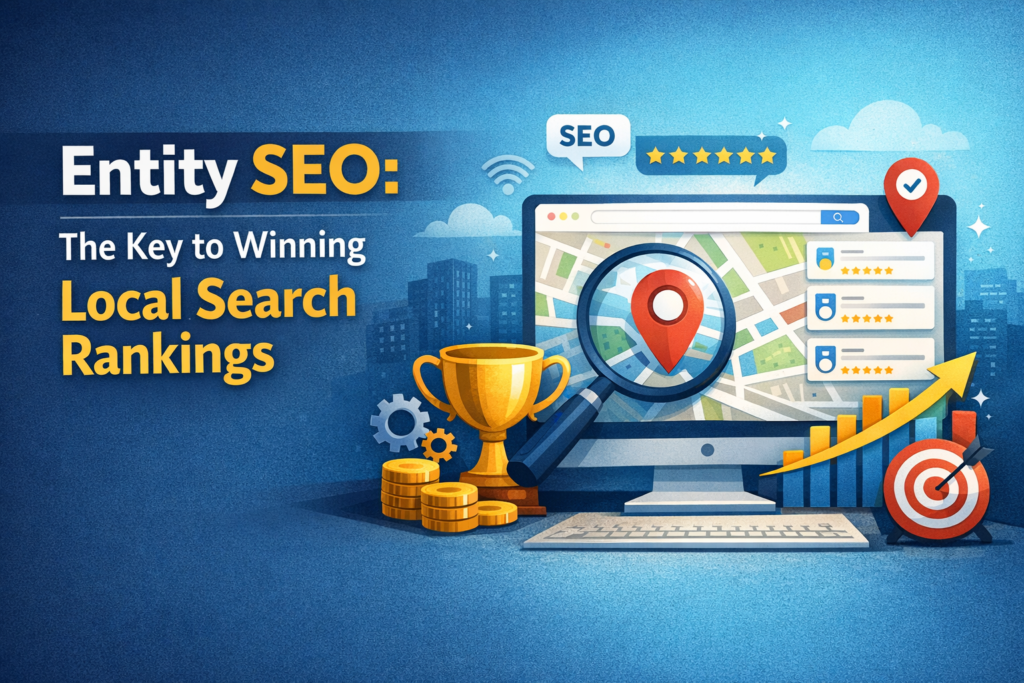
Search has evolved far beyond simple keyword matching. Today, search engines aim to understand context, intent, and relationships between concepts. This is where Entity SEO becomes a game changer, especially for businesses targeting local audiences. If you want to dominate local search rankings, you need to move beyond traditional tactics and start building your brand as a recognized entity.
What is Entity SEO?
Entity SEO focuses on optimizing your online presence around “entities” rather than just keywords. An entity can be a business, person, place, or concept that search engines can clearly identify and understand. Instead of relying solely on keyword density or backlinks, search engines now evaluate how well your business is defined, connected, and trusted across the web.
For example, a local dental clinic is not just a website with keywords like “best dentist near me.” It becomes an entity when search engines can associate it with its name, location, services, reviews, and reputation across multiple platforms.
Why Entity SEO Matters for Local Search
Local search results are heavily influenced by trust, relevance, and proximity. Entity SEO directly strengthens all three factors.
When your business is clearly defined as an entity, search engines gain confidence in showing your listing to users. This increases your chances of appearing in local packs, map results, and voice search queries.
Another advantage is consistency. When your business information is aligned across directories, social profiles, and your website, it sends strong signals of credibility. This reduces ambiguity and improves ranking stability over time.
How Search Engines Understand Entities
Search engines rely on structured data, knowledge graphs, and contextual signals to identify entities. They analyze multiple data points such as:
- Business name, address, and phone number (NAP)
- Website content and topical relevance
- Mentions across authoritative websites
- Reviews and ratings
- Social media presence
All these elements combine to create a clear digital identity. The more consistent and interconnected these signals are, the stronger your entity becomes.
Key Elements of Entity SEO for Local Businesses
1. Optimize Your Google Business Profile
Your Google Business Profile acts as the foundation of your local entity. Ensure that all details are accurate, complete, and regularly updated. Add high-quality images, services, business hours, and respond to reviews actively.
Consistency between your profile and website is critical. Even small discrepancies can weaken your entity signals.
2. Implement Structured Data
Structured data helps search engines understand your business in a machine-readable format. Using schema markup such as LocalBusiness, Organization, and FAQ schema enhances your chances of appearing in rich results.
It also improves how your business is represented in search features like knowledge panels and map listings.
3. Build Consistent Citations
Citations refer to mentions of your business across directories and websites. These include platforms like local listings, review sites, and business directories.
The key here is uniformity. Your business name, address, and phone number must remain identical everywhere. Inconsistent citations can confuse search engines and dilute your entity strength.
4. Create Topically Relevant Content
Content plays a major role in reinforcing your entity. Instead of targeting random keywords, focus on building topical authority within your niche.
For instance, if you run a legal practice, publish content around legal services, case studies, and local regulations. This helps search engines associate your entity with specific expertise.
Location-based content is equally important. Mention nearby areas, landmarks, and service regions naturally within your content.
5. Earn High-Quality Mentions and Links
Backlinks still matter, but in Entity SEO, context is more important than quantity. Mentions from authoritative and relevant websites strengthen your entity credibility.
Getting featured in local news, industry blogs, or community websites can significantly boost your trust signals. Even unlinked brand mentions contribute to entity recognition.
6. Leverage Reviews and User Signals
Reviews are not just for reputation; they are a strong entity signal. Positive, consistent reviews indicate trustworthiness and reliability.
Encourage satisfied customers to leave reviews and respond professionally to all feedback. Engagement shows that your business is active and credible.
User behavior signals such as clicks, dwell time, and interactions also contribute to how search engines perceive your entity.
Entity SEO vs Traditional SEO
Traditional SEO primarily focused on keywords, backlinks, and technical optimization. While these elements still matter, they are no longer sufficient on their own.
Entity SEO shifts the focus from “what you rank for” to “who you are.” It builds a holistic digital presence that search engines can understand and trust.
This approach is particularly effective in local SEO, where competition is high and differentiation is crucial.
Common Mistakes to Avoid
Many businesses attempt local SEO but fail to establish a strong entity due to avoidable mistakes.
One common issue is inconsistent business information across platforms. Even minor differences in address formatting can create confusion.
Another mistake is neglecting structured data. Without proper schema markup, search engines may struggle to interpret your business details accurately.
Ignoring reviews or failing to engage with customers also weakens trust signals. Similarly, relying only on keyword stuffing without building topical authority limits long-term growth.
The Future of Local SEO is Entity-Driven
With advancements in AI and semantic search, entity-based optimization is becoming the foundation of modern SEO. Search engines are moving towards understanding intent and relationships rather than just matching keywords.
Voice search, AI-generated results, and personalized search experiences all rely heavily on entity recognition. Businesses that invest in Entity SEO today will be better positioned for future algorithm changes.
Conclusion
Winning local search rankings is no longer about chasing keywords alone. It requires building a strong, consistent, and trustworthy digital identity.
Entity SEO helps search engines clearly understand who you are, what you offer, and why you are relevant to users. By focusing on structured data, consistent citations, quality content, and user trust signals, you can create a powerful local presence that stands out.
If your goal is to dominate local search results, the shift to Entity SEO is not optional—it is essential.