AI Overview have introduced a fundamental shift in how search engines present information. Instead of simply listing web pages, search engines now generate synthesized answers by pulling insights from multiple authoritative sources. This evolution means that ranking is no longer just about appearing on page one-it is about becoming a trusted source that AI systems choose to cite.
To succeed in this environment, SEO strategies must go beyond traditional optimization. You need to align your content with how AI understands, evaluates, and extracts information. This guide provides a complete technical checklist to help you consistently rank in AI Overviews in 2026.
Understanding AI Overview Ranking Signals
AI-driven search results rely heavily on semantic understanding rather than keyword matching. Search engines analyze context, relationships between topics, and the credibility of the source before selecting content for summaries.
What sets AI Overviews apart is their focus on delivering precise and reliable answers. This means your content must not only be relevant but also structured in a way that allows easy extraction. Pages that combine clarity, authority, and strong technical SEO are far more likely to be featured.
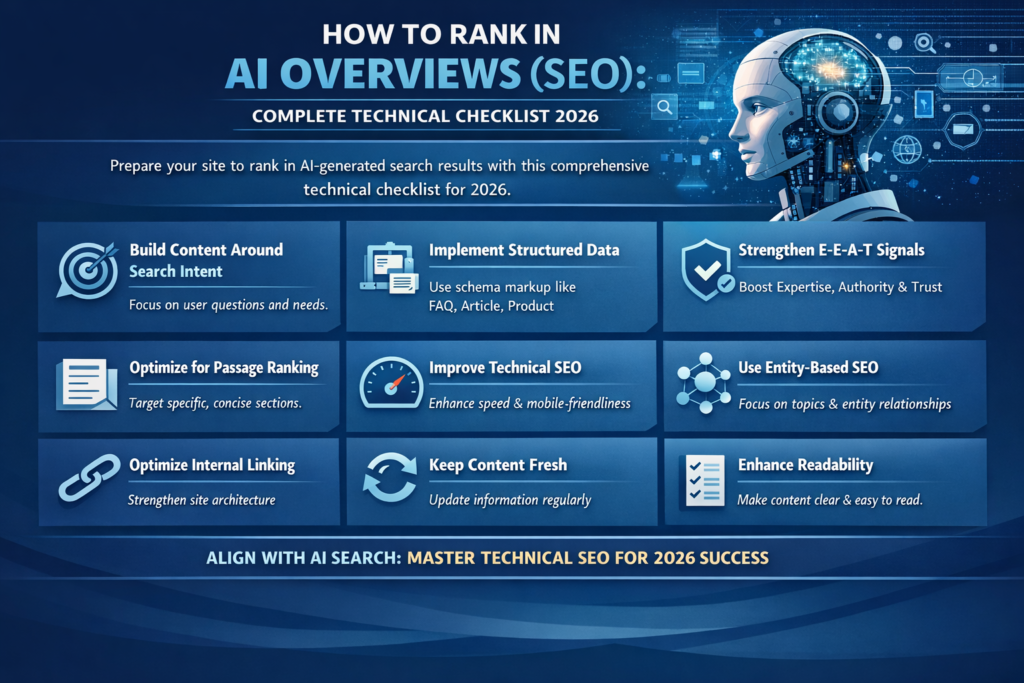
Build Content Around Search Intent
A major shift in SEO is the move from keyword targeting to intent-driven content creation. Instead of optimizing a page for a single keyword, your content should address the full spectrum of user queries related to a topic.
For example, if you are targeting a query related to home loan interest rates, your content should naturally expand into related areas such as calculation methods, influencing factors, and current trends. This layered approach helps AI systems understand the depth of your content and improves your chances of being selected.
Well-structured content that answers primary and secondary questions within the same page performs significantly better in AI-generated summaries.
Use Structured Data to Enhance Machine Readability
Structured data plays a crucial role in helping search engines interpret your content. By implementing schema markup, you provide explicit signals about the type and purpose of your content.
Adding FAQ schema allows your question-answer sections to be easily identified, while article schema helps define the structure of your blog content. Breadcrumb schema further clarifies your site hierarchy, making it easier for search engines to understand relationships between pages.
While structured data alone does not guarantee placement in AI Overviews, it significantly increases your eligibility by improving how your content is processed.
Strengthen E-E-A-T for Trust and Authority
AI systems prioritize content from sources that demonstrate strong Experience, Expertise, Authoritativeness, and Trustworthiness. This means your content must go beyond surface-level information and reflect genuine knowledge.
Including detailed author bios, citing credible sources, and maintaining factual accuracy are essential practices. Real-world examples, case studies, and updated data further reinforce your authority.
Websites that consistently demonstrate trust signals are more likely to be referenced in AI-generated answers, especially for competitive queries.
Optimize for Passage-Level Extraction
One of the defining characteristics of AI Overviews is their ability to extract specific sections from a page rather than relying on the entire document. This makes passage-level optimization a critical factor.
Each section of your content should be structured to answer a specific question clearly and directly. Using descriptive subheadings and maintaining a logical flow helps search engines identify relevant passages.
When your content is organized into well-defined sections, it becomes easier for AI systems to extract and display it as part of a summary.
Strengthen Technical SEO Foundations
Even the most well-written content can fail to rank if the technical foundation is weak. AI systems prefer websites that are fast, accessible, and easy to crawl.
Optimizing Core Web Vitals ensures your pages load quickly and provide a smooth user experience. Mobile responsiveness is equally important, as most searches now occur on mobile devices. Clean HTML structure, proper indexing, and the use of canonical tags help eliminate confusion and improve crawl efficiency.
Technical SEO is not just a supporting factor—it is a prerequisite for visibility in AI-driven search results.
Leverage Entity-Based SEO
Modern search engines rely on entities to understand context and relationships between topics. Instead of focusing solely on keywords, you should build content around clearly defined topics and their connections.
Creating content clusters around a central theme helps establish topical authority. For instance, covering various aspects of home loans within a structured framework strengthens your relevance in that domain.
By consistently using clear terminology and linking related topics, you make it easier for AI systems to recognize your expertise and include your content in summaries.
Optimize Internal Linking for Context
Internal linking plays a significant role in helping search engines understand your website structure. When pages are connected logically, it becomes easier to establish relationships between topics.
Linking related articles using descriptive anchor text improves navigation and distributes authority across your site. It also reinforces the depth of your content, which is a key factor in AI selection.
A well-planned internal linking strategy ensures that your content is not only discoverable but also contextually relevant.
Maintain Content Freshness and Relevance
AI Overviews prioritize content that reflects the most current and accurate information. This makes regular updates an essential part of your SEO strategy.
Refreshing outdated statistics, adding new insights, and updating examples help maintain relevance. Content that evolves with changing trends is more likely to be trusted and featured.
Consistency in updating your content signals reliability, which directly impacts your chances of ranking.
Improve Readability and Content Clarity
Clarity is a critical factor in AI-driven SEO. Content that is easy to read and understand is more likely to be extracted and displayed.
Using simple language, logical structure, and clear explanations ensures that both users and AI systems can interpret your content effectively. Avoid unnecessary complexity and focus on delivering value in a straightforward manner.
Readable content not only improves user engagement but also enhances your visibility in AI-generated results.
Monitor Performance and Continuously Optimize
SEO for AI Overviews is not a one-time effort. It requires continuous monitoring and refinement based on performance data.
Tracking impressions, engagement metrics, and query-level performance helps identify what is working and what needs improvement. By analyzing these insights, you can refine your content strategy and stay ahead of evolving search trends.
Adaptability is key in an AI-driven search landscape, where algorithms are constantly evolving.
Conclusion
Ranking in AI Overviews requires a shift in mindset from traditional SEO practices to a more holistic approach that combines content quality, technical excellence, and semantic relevance. Websites that focus on clarity, authority, and structured information will have a significant advantage.
By following this technical checklist, you position your content to not only rank but also become a trusted source for AI-generated answers. As search continues to evolve, those who prioritize understanding and usability will lead the way.