Organic traffic is one of the most important indicators of a website’s search visibility. However, a decline in organic visitors does not always mean that your SEO strategy has failed.
Search has changed significantly. Google now provides more information directly within search results, while AI-powered search experiences are changing how users discover and consume information. As a result, a website can maintain strong rankings and still experience fewer clicks.
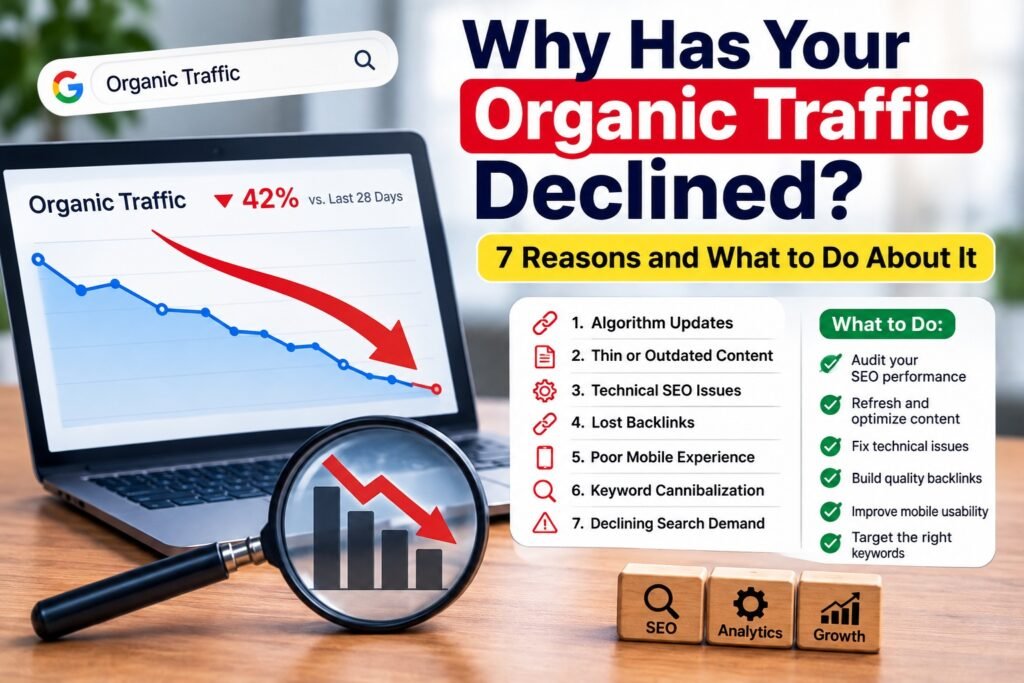
If your Organic traffic declined, the first step is to identify what caused the change. Here are seven common reasons organic traffic may decline and practical ways to respond.
1. AI Overviews and AI Search Are Reducing Website Clicks
Search engines are increasingly answering users’ questions directly within the results page.
Google’s AI-powered search experiences can summarize information from multiple sources, allowing users to find answers without necessarily visiting individual websites. This can reduce clicks even when your content continues to appear prominently in search.
For example, a page ranking among the top organic results for a question such as “how does SEO work?” may receive fewer visitors if the search engine provides a detailed answer before users reach the traditional listings.
What should you do?
Don’t focus exclusively on rankings. Monitor:
- Organic impressions
- Click-through rate
- Search queries
- Conversion rate
- Branded searches
- AI search visibility
- Traffic by landing page
- Traffic by search intent
Your objective should be to become a source users and search engines consider valuable—not simply to occupy a particular ranking position.
2. Zero-Click Searches Are Becoming More Common
A zero-click search occurs when a user finds what they need without clicking through to a website.
Featured snippets, knowledge panels, local results, calculators, FAQs, maps and AI-generated answers can all satisfy a searcher’s intent directly on the results page.
This means impressions can remain stable while clicks decline.
For example, a user searching for a business’s opening hours may get the information directly from the search results. Someone searching for a simple definition may also have no reason to visit a website after reading the featured answer.
How to respond
Optimize for visibility across the entire search experience rather than focusing only on traditional organic listings.
Consider optimizing for:
- Featured snippets
- People Also Ask
- Local search results
- Google Business Profile
- Image search
- Video results
- AI-generated search results
- Branded search visibility
3. Informational Content May Be Losing Traffic
Informational content has traditionally been an effective way to attract visitors at the top of the marketing funnel.
Articles targeting searches such as “what is,” “how to,” “best ways to” and “benefits of” can generate substantial organic visibility. However, many of these searches can now be answered directly within search results.
That doesn’t mean informational content is no longer useful. Instead, generic content has become easier for search engines and AI systems to summarize.
Make your content more valuable
Give users information they cannot easily obtain from a generic summary.
Include:
- Original research
- Expert opinions
- First-hand experience
- Case studies
- Industry-specific examples
- Data and statistics
- Original images or demonstrations
- Practical recommendations
- Detailed comparisons
The goal is to create content that provides a reason to visit your website rather than simply repeating information already available elsewhere.
4. SERP Features Can Push Organic Listings Down
Search results pages are no longer made up of ten traditional blue links.
Depending on the query, users may encounter ads, local packs, featured snippets, videos, images, shopping results, People Also Ask questions, news stories and other search features before reaching traditional organic listings.
Consequently, a page can maintain its ranking while receiving fewer clicks.
This is particularly important on mobile devices, where limited screen space means traditional organic results may appear much farther down the page.
What to check
When investigating a traffic decline, review the actual search results for your important keywords.
Look for changes such as:
- New SERP features
- More advertisements
- New competitors
- Local packs
- Featured snippets
- Video results
- AI-generated answers
- Forum or community results
Ranking reports alone may not reveal these changes.
5. Users May Prefer Forums, Reviews and Community Content
Searchers increasingly look for genuine experiences when researching products, services and businesses.
For certain queries, users may prefer discussion forums, review platforms, social media communities and first-hand experiences over highly polished commercial content.
This is especially common for searches involving:
- Product recommendations
- Comparisons
- Reviews
- Personal experiences
- Troubleshooting
- Purchasing decisions
How businesses can respond
Don’t make every piece of content sound like a sales pitch.
Instead, demonstrate genuine expertise and experience. Include real examples, customer questions, practical insights, original opinions and evidence that supports your recommendations.
Building a recognizable brand also helps. When users already know and trust your company, they are more likely to choose your website when they encounter it in search.
6. Your Website May Have Technical or Content Problems
Not every traffic decline is caused by changes in search behavior.
Sometimes the problem is technical.
A sudden drop should trigger a review of your website’s technical health and recent changes.
Check for:
- Accidental noindex tags
- Robots.txt restrictions
- Incorrect canonical tags
- Broken redirects
- 404 errors
- Server problems
- Indexing issues
- Website migrations
- Lost backlinks
- Broken internal links
- Slow page performance
- Duplicate content
- Deleted or substantially changed pages
Google Search Console should be one of the first tools you review when investigating a significant organic traffic decline.
Compare the period before and after the drop to determine whether impressions, clicks, indexed pages or search positions changed.
7. Search Demand and Seasonality May Have Changed
Sometimes your website is performing normally, but fewer people are searching for the topics you rank for.
Search demand changes throughout the year because of seasonality, holidays, economic conditions, industry trends, news events and changes in consumer behavior.
For example, a website may experience lower traffic during a traditionally slow period even though rankings and conversion rates remain stable.
Therefore, don’t evaluate organic traffic only by comparing one month with the previous month.
Instead, compare:
- Year-over-year traffic
- Search impressions
- Search volume
- Rankings
- CTR
- Conversions
- Revenue
- Seasonal trends
This gives you a more accurate picture of whether the website actually lost visibility or whether demand simply decreased.
What Should You Do When Organic Traffic Falls?
Don’t immediately start changing titles, publishing dozens of articles or rebuilding your website.
First, determine exactly where the decline occurred.
Step 1: Identify the affected pages
Use Google Analytics and Google Search Console to identify which URLs experienced the biggest losses.
Separate pages into categories such as:
- Blog posts
- Service pages
- Product pages
- Location pages
- Category pages
- Homepage
This can reveal whether the decline is sitewide or limited to a specific content type.
Step 2: Analyze queries and search intent
Compare the keywords that previously generated traffic with their current performance.
Look for:
- Ranking declines
- CTR decreases
- Changes in search intent
- New competitors
- SERP feature changes
- Reduced search demand
A ranking that remains stable while CTR falls may indicate a search-results-page change rather than an SEO failure.
Step 3: Review your competitors
Search your most important keywords manually.
Compare your content with the pages currently receiving visibility.
Ask:
- Is competitor content more comprehensive?
- Does it demonstrate stronger expertise?
- Does it provide original information?
- Is the page more useful?
- Does it better satisfy search intent?
- Does the competitor have stronger brand recognition?
Your competitors may have changed even if Google’s algorithm hasn’t.
Step 4: Improve existing content
Don’t assume that publishing more content is always the answer.
Your existing pages may contain valuable information that can be improved.
Update outdated statistics, strengthen examples, improve internal linking, add expert insights, answer related questions and make the page easier to navigate.
Focus on improving quality rather than increasing content volume.
Step 5: Track business outcomes—not just traffic
Organic sessions are useful, but they shouldn’t be your only SEO KPI.
A website receiving fewer visitors can still produce better business results if it attracts more qualified users.
Track:
- Leads
- Sales
- Revenue
- Conversion rate
- Qualified traffic
- Branded searches
- Assisted conversions
The ultimate objective of SEO is not simply to generate more visits. It is to attract the right audience and turn search visibility into meaningful business results.
How to Build a More Resilient SEO Strategy
The modern search environment requires a broader approach to organic visibility.
Create content with a unique point of view
Avoid publishing another generic article that repeats information already available across hundreds of websites.
Use expertise, original data, examples, opinions and experience to make your content distinctive.
Strengthen your brand
Brand recognition can influence whether users choose your website over an unfamiliar competitor.
Maintain consistent messaging across your website, social profiles, business listings, review platforms and other digital channels.
Optimize for multiple search experiences
Traditional rankings remain important, but search visibility now extends beyond standard organic listings.
Consider your presence across local results, images, videos, featured snippets, AI search, reviews and other discovery platforms.
Diversify traffic sources
Organic search should be an important acquisition channel, but businesses should avoid becoming completely dependent on it.
Build complementary channels through:
- Email marketing
- Social media
- Video
- Referral partnerships
- Digital PR
- Paid advertising
- Online communities
- Direct traffic
- Customer referrals
A diversified acquisition strategy makes your business less vulnerable to changes in search algorithms and user behavior.
Final Thoughts
A decline in organic traffic does not automatically mean your SEO strategy is failing.
Search behavior is changing. AI-generated answers, zero-click searches, expanding SERP features, changing user preferences and fluctuations in search demand can all affect website traffic.
At the same time, genuine technical problems, outdated content, lost rankings and weaker search intent alignment can also cause traffic losses.
The key is to diagnose the problem before taking action.
Look beyond rankings and sessions. Analyze impressions, CTR, search queries, landing pages, conversions, competitors, search demand and SERP changes together.
Most importantly, build a search strategy around visibility, authority, user value and business outcomes rather than chasing rankings alone.
SEO remains valuable—but successful SEO increasingly means being discoverable wherever your potential customers search, compare and make decisions.